

Learning objective
Students explore different emotions, the signals their bodies give for each emotion, and positive coping strategies for different scenarios.
Take home messages
Curriculum links
WA HPE Curriculum
Sub-strand: Staying safe
- Protective behaviours and help-seeking strategies to keep safe
- Strategies to use when help is needed
- Strategies to use when needing to seek, give or deny permission are practised
Sub-strand: Interacting with others
- Skills and strategies to develop respectful relationships
- Positive ways to react to their own emotions in different situations
WA HPE Curriculum
Sub-strand: Staying safe
- Protective behaviours and help-seeking strategies to keep safe
- Strategies to use when help is needed
- Strategies to use when needing to seek, give or deny permission are practised
Sub-strand: Interacting with others
- Skills and strategies to develop respectful relationships
- Positive ways to react to their own emotions in different situations
WA Curriculum General Capabilities
Personal and social capability
- Self-awareness
- Social awareness
- Social management
International technical guidance on sexuality education
Key concept 4.2 Consent, Privacy and Bodily Integrity
- Everyone has the right to decide who can touch their body, where, and in what way
Materials
- Book or YouTube reading of I have feelings! by Jana Novotny Hunter
- Large sheets of butchers paper to draw body outline - can be life size (for children to draw around their own bodies or scaled down and pre-drawn).
- Markers, crayons, pencils or paints.
- Optional: scrap craft materials.
Before you get started
- Protective interrupting - Teachers need to know and understand how to use this technique to prevent students from potentially disclosing sensitive information or abuse in front of other students.
- Managing disclosures - Teachers must be aware of school and legal procedures if a student discloses personal issues, particularly disclosures of sexual abuse.
Learning activities
Group agreement
5 mins
Teaching tip: A group agreement must be established before any Relationships and Sexuality Education (RSE) program begins to ensure a safe learning environment. Read: Essential tools: Establishing a group agreement for tips on how to create one and what to include.
- Revise or create the class group agreement.
Trigger warning: Let students know you will be talking about relationships, both healthy and unhealthy relationships. Reiterate you want everyone to have safe, healthy, positive relationships, and while we will be promoting healthy behaviours, we do need to discuss unhealthy behaviours. Remind students of their right to pass and to speak to teacher/other support if required.
Book: I have feelings!
10 min
Whole Class
Teacher to read:
Read I have feelings! book
- Read the book a second time stopping at each emotion.
- Ask students to show the way the possum is feeling with the body language, facial expressions and words.
- Draw attention to the different body signals the students are demonstrating for each emotion.
E.g. Happy - large open eyes, arms in the air, smile, warm feeling in belly, etc.
Body outlines
30 min
Independent or Small Group
- Divide the students into groups of 3 or 4 using a grouping strategy.
- Give each group some large butchers paper to trace around one person's body.
- Allocate each group with a different emotion - sad, angry, scared, happy, excited, frustrated, loved, calm, silly, etc.
Ask students to draw body signals on the body outline to represent their allocated emotion. Optional: use scrap craft materials to represent body signals.
E.g. Scared - squiggly drawing in tummy, clenched teeth, knees shaking, frozen still, eyes wide, mouth open
Teaching tip: It is important to draw attention to the fact that different people can have different body reactions to the same emotion. People can also have different body signals for the same emotion in different scenarios. The flight/fright/fawn/freeze response is an example of this.
- Display the body outlines and share each groups response.
Positive coping strategies
10 mins
Whole Class
- Use the body outlines as visual prompts to discuss the following questions:
If we are feeling silly, is it OK to run around the classroom and bump into each other?
(No, it could hurt someone or break something)
What are some positive things we can do to get the sillys out?
(Wiggly our bodies to some music, run around the playground, laugh with our friends)
If we are feeling angry, what things might someone do that are unhelpful or unsafe?
(Hit, scream, break something, etc)
What are some positive things we can do to help if we are angry?
(Hit a pillow, scream into a pillow, run around outside, talk to a friend or trusted adult, do something we enjoy, listen to calming music, eat some food or have a drink, etc)
- Continue for other emotions that students have created body signals for.
3-2-1 Reflection
10 min
Whole Class
- Ask:
Which of these body signals might someone notice if they were feeling unsafe?
(sweaty palms, butterflies in tummy, feel unwell, heart racing, frozen, etc)
- Say:
"These body signals are very important. They are warning us that we might not be safe. If we listen to our body signals carefully, they can help keep us out of danger."
- Ask:
What can we do if we start to feel any of these warning signs?
(talk to a trusted adult, don't ignore the signals, tell a friend, move away, call 000 if it is an emergency, etc)
- Give a first introduction to the 'helping hand' network by asking students to list their 5 trusted adults (one for each finger) to themselves.
Health promoting schools
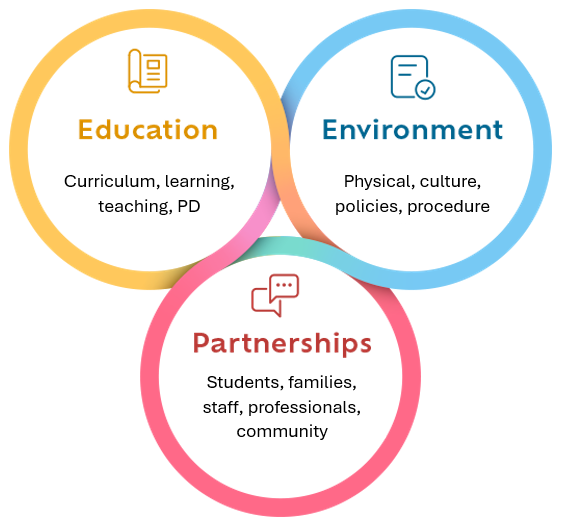
Refer to Guiding principle: Health promoting schools - a whole school approach for further information on implementing a whole school approach.
Family
- Talk Soon. Talk Often: a guide for parents talking to their kids about sex is a free hardcopy resource that can be bulk ordered by schools and website. Send a copy home to parents prior to starting your RSE program. The booklet offers ages and stage related information on puberty (and other topics) so that parents can reinforce the topics covered in class. (How to order hard copies.) Provide the link to parents on school websites and social media.
- Share information with parents and carers surrounding key messages and protective behaviours language to reinforce learning at home.