
Learning objective
Students learn how consent is communicated across various relationships and the underpinning elements that make consent assertive and respectful.
Take home messages
Curriculum links
WA HPE Curriculum
Sub-strand: Staying safe
- Strategies and skills to communicate assertively when seeking, giving or denying consent are explained and applied.
Sub-strand: Interacting with others
- Strategies for managing the changing nature of peer and family relationships
WA Curriculum General Capabilities
Critical and creative thinking
- Reflecting
Personal and social capability
- Self-awareness
- Social awareness
- Social management
International technical guidance on sexuality education
1.1 Families
- Conflict and misunderstandings between parents/guardians and children are common, especially during adolescence, and are usually resolvable
1.2 Friendship, Love and Romantic Relationships
- There are different kinds of relationships
5.3 Communication, Refusal and Negotiation Skills
- Good communication is essential to personal, family, school, work and romantic relationships
Materials
- Butchers paper
- Coloured pens
- Whiteboard and whiteboard pens
- Ball of wool - for reflection activity
Before you get started
- Protective interrupting - Teachers need to know and understand how to use this technique to prevent students from potentially disclosing sensitive information or abuse in front of other students.
- Managing disclosures - Teachers must be aware of school and legal procedures if a student discloses personal issues, particularly disclosures of sexual abuse.
- It is recommended to read the Educator Notes: Consent prior to teaching this activity.
Learning activities
Group agreement
5 mins
Teaching tip: A group agreement must be established before any Relationships and Sexuality Education (RSE) program begins to ensure a safe learning environment. Read: Essential tools: Establishing a group agreement for tips on how to create one and what to include.
- Revise or create the class group agreement.
Trigger warning: Let students know you will be talking about relationships, both healthy and unhealthy relationships. Reiterate you want everyone to have safe, healthy, positive relationships, and while we will be promoting healthy behaviours, we do need to discuss unhealthy behaviours. Remind students of their right to pass and to speak to teacher/other support if required.
Consent in different relationship types
30 minutes
- Ask class to name 6 different types of relationships (e.g. coach/player, teacher/student, parent/child, romantic partners, friends etc.)
- Split class into 6 groups and assign one relationship type per group
- Each group is given a piece of butcher's paper. Ask group to create 3 columns on the page.
- For each column, write a consent scenarios that may occur in that relationship type (e.g. asking to borrow a t-shirt (sibling), asking if they can play a different position (coach) etc.)
- For each scenario, list a way to respectfully respond and a way to disrespectfully respond.
- Ask groups to switch paper with another group.
- As a group, choose one respectful and one disrespectful scenario response to expand on.
- Break down what makes the response respectful or disrespectful - wording, body language, relationship type etc.
Developing assertive and respectful responses
20 minutes
- Ask groups to develop an assertive and respectful response to the below scenarios:
- Your boss asks you to stay at a shift longer but you know they often do this without extra pay that you're entitled to...
- Your coach keeps you on the bench for most of the games even though you go to training more than other team members...
- You give your brother permission to use your camera on Saturday but it's Sunday and he hasn't returned it yet...
- You tell your friend a secret and they tell the rest of your friendship group...
- Your partner planned a date at the movies on the weekend and cancels two hours before with a text message saying, 'Something's come up'...
Ask groups:
How they decided how they would respond to the scenarios? What personal values did you have to assess or discuss to get to a conclusion?
What are the main criteria that you've noticed that makes a response assertive and respectful?
How would you respond if your response was dismissed or ignored? What could you do and who could help?
3-2-1 Reflection
Spaghetti reflection
10 minutes
- In a circle, pass a ball of wool around by holding on to the wool before throwing the ball of wool to the next person so that it creates a web of wool (that looks like a bowl of spaghetti).
Ask each student:
What is a respectful action/phrase that can be used when giving/receiving consent related scenarios?
"that's okay we don't have to" "is there something else you'd like to do?" " is there anything else you wanted me to know?" "thank you for telling me" etc.
Health promoting schools
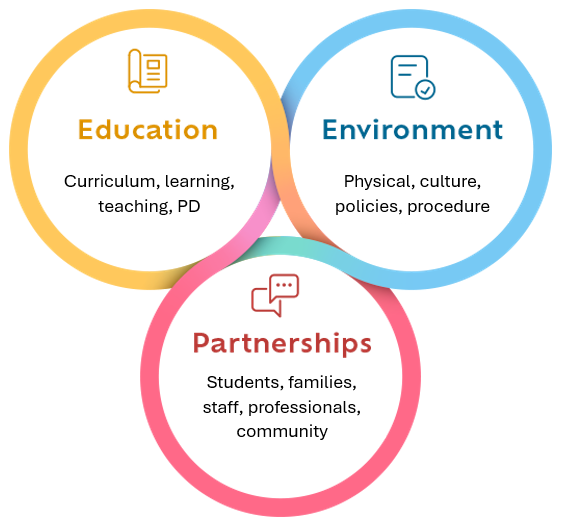
Refer to Guiding principle: Health promoting schools - a whole school approach for further information on implementing a whole school approach.
Family
- Talk Soon. Talk Often: a guide for parents talking to their kids about sex is a free hardcopy resource that can be bulk ordered by schools and website. Send a copy home to parents prior to starting your RSE program. The booklet offers ages and stage related information on puberty (and other topics) so that parents can reinforce the topics covered in class. (How to order hard copies.) Provide the link to parents on school websites and social media.
- Provide students with a copy of Relationships, Sex and Other Stuff to take home and read and discuss with their family.
Students
- Students can develop helpful resources such as posters, or presentations to deliver to younger year groups (Years 4-7), highlighting the difference between assertive and respectful vs disrespectful communication.