
Learning objective
Students discuss and learn about the ways that consent can be communicated including verbal and physical cues.
Take home messages
Curriculum links
WA HPE Curriculum
Sub-strand: Staying safe
- Protective behaviours that can be implemented in uncomfortable or unsafe situations
- Strategies for seeking, giving or denying consent are described, and how to communicate intentions effectively are rehearsed
Sub-strand: Interacting with others
- Skills and strategies to establish and maintain respectful relationships
WA Curriculum General Capabilities
Personal and social capability
International technical guidance on sexuality education
Key concept 4.2 Consent, Privacy and Bodily Integrity
- It is important to understand what unwanted sexual attention is and the need for privacy when growing up.
Materials
- Butchers paper
- Coloured pens - enough for each student
Before you get started
- Protective interrupting - Teachers need to know and understand how to use this technique to prevent students form potentially disclosing sensitive information or abuse in front of other students.
- Dealing with disclosures - Teachers must be aware of the school and legal procedures if a student discloses personal issues, particularly disclosures of sexual abuse.
Learning activities
Group agreement
5 mins
Teaching tip: A group agreement must be established before any Relationships and Sexuality Education (RSE) program begins to ensure a safe learning environment. Read: Essential tools: Establishing a group agreement for tips on how to create one and what to include.
- Revise or create the class group agreement.
Trigger warning: Let students know you will be talking about relationships, both healthy and unhealthy relationships. Reiterate you want everyone to have safe, healthy, positive relationships, and while we will be promoting healthy behaviours, we do need to discuss unhealthy behaviours. Remind students of their right to pass and to speak to teacher/other support if required.
Consent communication brainstorm
25 minutes
- Discuss how consent can be communicated in lots of different ways. It’s not just saying yes or no so it’s important to make sure that you are aware and think about all the ways people can say yes or no.
Ask:
What are some situations where you need to ask for consent or give consent?
- Using a grouping strategy, divide the group into 6 groups. Students will complete the task in a Gallery walk format.
- Give each group a piece of butcher’s paper and pens. Each group to brainstorm one of the following, what:
- Giving consent looks like
- Not giving consent looks like
- Giving consent sounds like
- Not giving consent sounds like
- Giving consent feels like
- Not giving consent feels like
- Giving consent looks like
- Once groups have had adequate time to brainstorm (roughly 15 minutes), encourage everyone to walk around and add their own thoughts to the other pieces of butcher’s paper.
- Ask someone from each group to share what they brainstormed or discussed.
Teaching tip: If not mentioned naturally in sharing discussions make sure to mention
- Sometimes people can “freeze” if they feel uncomfortable or unsafe. This might mean they don’t move or respond verbally, so it’s important to know that no response is also a no response.
- Some people do not communicate verbally, so understanding their non-verbal cues are important to understanding when and how they consent.
Consent clarification
15 minutes
- Assign each corner of the room as A, B or C.
- A = Yes they consent
- B = No they don’t consent
- C= Unsure if they consent so would need to clarify.
Ask students to stand in the corner that they think is correct when answering the following questions:
You ask your Mum if they want an ice cream, they shake their head from side to side and pull a disgusted looking face.
You ask your sister if you can borrow their new top and they say, “umm, what do you think?”
You text your boyfriend/girlfriend and ask if they want to come over after school and they send you back a party emoji and say, “sounds good, can’t wait”.
You notice that a friend is upset and ask if you can give them a hug to cheer them up. They turn away and look down at the floor.
You text a friend to ask if you can share a photo of you together from the sports carnival online. They reply with "are you serious..."
It's the school disco and you ask your friend to dance. This friend is always your partner when you practice during dance lessons. They respond with "hmm, maybe later".
You're at the park and notice your favourite breed of dog running around - a bouncy golden retriever. You can see the owner all the way on the other side of the park and yell out "can I please pat your dog?" It's probably too far for them to hear you, but they didn't say no.
Teaching tip : You can adjust the examples to use different language terms to be culturally inclusive or mention communication devices or sign language to be more disability inclusive.
3-2-1 Reflection
Reflection questions
5 minutes
Ask:
How can you clarify consent?
Was there anything new that you learned or were surprised by today?
What is one thing we talked about today that you'd share with a friend or family member?
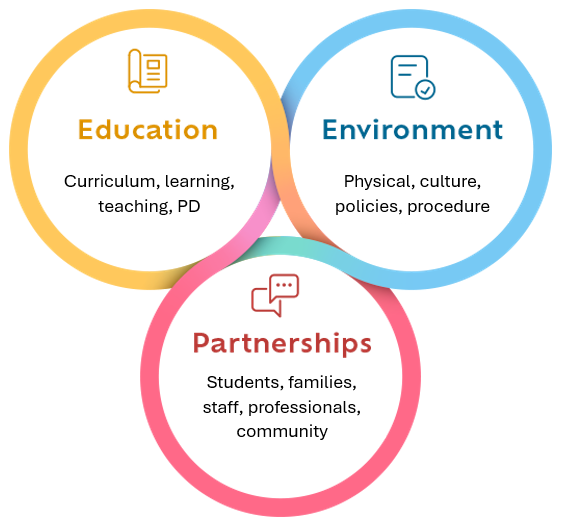
Health promoting schools
Refer to Guiding principle: Health promoting schools - a whole school approach for further information on implementing a whole school approach.
Partnerships
Family
- Talk Soon. Talk Often: a guide for parents talking to their kids about sex is a free hardcopy resource that can be bulk ordered by schools and website. Send a copy home to parents prior to starting your RSE program. The booklet offers ages and stage related information on puberty (and other topics) so that parents can reinforce the topics covered in class. (How to order hard copies.) Provide the link to parents on school websites and social media.
- Provide students with a copy of Puberty booklet to take home and read and discuss with their family.
- In school newsletters, include a question similar to those in the consent clarification game that offers an A, B or C answer so that students and families can discuss and share their thoughts on different situations and circumstances.
Education
Learning
- Ask the drama and arts teachers if they can draw upon plays or art pieces that portray consent related scenarios to imbed for cross sectional knowledge.
- Ask sport teachers to discuss how we show consent in sport i.e. shaking head, crossing hands, saying don't pass etc.