Image


Students use a scenario and emotion statues to explore consent for photos to be shared and actions they can take if someone has shared photos without consent.
Sub-strand: Staying safe
Sub-strand: Interacting with others
Key concept 4.3 Safe Use of Information and Communication Technologies (ICTs)
Key concept 5.3 Communication, Refusal and Negotiation Skills
Key Concept 5.3 Communication, Refusal and Negotiation Skills
Personal and Social Capability
Digital Literacy
Ethical Understanding
Protective interrupting - Teachers need to know and understand how to use this technique to prevent students from potentially disclosing sensitive information or abuse in front of other students.
Managing disclosures - Teachers must be aware of school and legal procedures if a student discloses personal issues, particularly disclosures of sexual abuse.
This activity is a revision of the concept of the CUPS framework covered in Year 2 lesson: Consent and communication. More time and detailed explanation may be required if this is a new consent to the class.
Teaching tip: A group agreement must be established before any Relationships and Sexuality Education (RSE) program begins to ensure a safe learning environment. Read: Essential tools: Establishing a group agreement for tips on how to create one and what to include.
Trigger warning: Let students know you will be talking about relationships, both healthy and unhealthy relationships. Reiterate you want everyone to have safe, healthy, positive relationships, and while we will be promoting healthy behaviours, we do need to discuss unhealthy behaviours. Remind students of their right to pass and to speak to teacher/other support if required.
Ask:
What do you think the word 'consent' means?
(Agreeing to do something, giving permission, letting someone do something, saying 'yes', when everybody involved agrees to what is happening)
Explain
There are some important rules about consent. The word 'CUPS' can help us remember these rules. Let's use hugging as an example to explain the rules about consent.
C - change mind - you are allowed to change your mind at any time. E.g. If you say, 'yes' to a hug. and then you don't want to, that is OK. The person is no longer allowed to hug you. And if you have said, 'yes' to a hug before, it does not mean it is OK for the person to hug you every time they see you. They have to ask each time.
U - understand - you have to understand what you are agreeing to. E.g. If a person asks you for a hug and then they try to give you a kiss, this is not OK and is not consent.
P - pressure is not OK - if someone is pressuring you, this is not OK and not consent. E.g. If someone says something like, 'If you don't give me a hug, I won't be your friend anymore.'
S - sure - if you are not sure if you want to be touched, and the person is not sure if you have given consent, they are not allowed to touch you. E.g. If someone asks for a hug and you shrug your shoulders and say, 'maybe', this is to consent and the person is not allowed to give you a hug until they are sure you are OK with it.
Ask:
What are some examples of when we need to ask for consent (or permission)?
(To touch another person - hugs, kisses, holding hands, tickling, playing; joining a team; joining a game - online or offline; sharing a photo online; sharing food; borrowing something; accepting a friend request online).
Explain:
"Asking for consent, and listening to the answer, is an important way for us to show respect to other people. One situation where we need to ask for consent is sharing photos."
Ask:
How might someone share a photo?
(Show them on a phone/tablet, show them a printed photo, put it on a website, post on social media, send in a message, share in group chat, etc)
Scenarios:
One: Ali and Max are good friends. On the weekend Ali went over to Max's house for the afternoon. They were having fun playing lots of different games and taking silly photos. On Monday, Max posted the photos on social media. Ali doesn't want the photos posted online.
Should Max have asked first?
Two: Sam makes a funny face at a birthday party over the weekend. His classmate Jamie secretly takes a photo and sends it to his other friend without asking. Sam is now upset.
What should Jamie do now?
Three: Ava trips while running and falls over. Instead of helping, Liam takes a picture and shows it to others later.
What could Liam have done instead? How can we help when someone is hurt or embarrassed?
Four: Kayla is wearing a costume for a class play rehearsal. Her twin brother Ben takes a photo and shares it with some of his friends before Kayla is ready to show anyone.
When is it okay to share photos?
Five: On a school excursion, Mia falls asleep on the bus. An older student that Mia doesn't know takes a picture and posts it in a group chat.
Did Mia give permission? What should the other student do after realising it wasn't okay?
Six: Ethan draws a picture he feels shy about. Alex thinks it's really impressive and takes a photo that they share with others in the class.
Are some things meant to stay private? What is a good way to be a trusted friend?
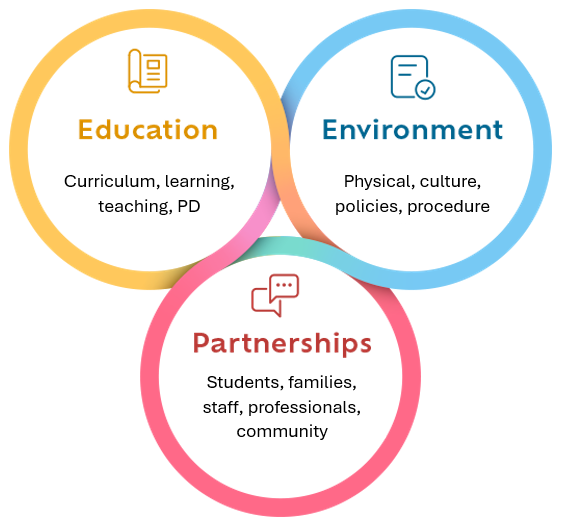
Refer to Guiding principle: Health promoting schools - a whole school approach for further information on implementing a whole school approach.
Family
Curriculum/Policies/Physical