Image


Students explore legal, physical, social and emotional safety, and respectful relationships using a placemat strategy and the Laugh and learn video as a stimulus.
Explores the importance of communicating with a partner about readiness for sexual activity, including consent and boundaries.
Optional: Take home activity_reliable RSE websites
Teaching tip: A group agreement must be established before any Relationships and Sexuality Education (RSE) program begins to ensure a safe learning environment. Read: Essential tools: Establishing a group agreement for tips on how to create one and what to include.
Trigger warning: Let students know you will be talking about relationships, both healthy and unhealthy relationships. Reiterate you want everyone to have safe, healthy, positive relationships, and while we will be promoting healthy behaviours, we do need to discuss unhealthy behaviours. Remind students of their right to pass and to speak to teacher/other support if required.
Say:
"In this video there are some words and phrases that need some thinking about and discussing before we get to see the video."
Divide the class into groups to discuss the following questions. Ask for responses from each group.
What do you think 'ramification' means? Use a dictionary if you don't know.
(Consequence, result, aftermath, outcome, effect.)
Thinking about the topic of 'staying safe in a sexual situation' - what do you think would be covered in a 'proper talk'?
(e.g., Communicating about individual wants and what you're okay with; consent for sexual activities; STI and pregnancy prevention.)
What do you understand 'safe sex' measures to be?
(Using a condom to prevent STIs and/or pregnancy, using a contraceptive method to prevent pregnancy and not engaging in activity that is harmful.)
Explain:
"The term 'safe sex' and 'safer sex' are often used interchangeably. In this video the term 'safe sex' is used, however, the more accurate term is 'safer sex' as no sexual activity is 100% safe."
Laugh and learn - keeping safe (2min 8sec)
What do you think of the use of humour in this video?
Does it help get information across? How?
What is the message/information you got from this video?
(e.g. it is important to talk about safer sex beforehand; both partners need to be ready; the age of consent in WA is 16; partners should be aware of what each other want; consent is vital)
"While humour is useful and we can laugh at some aspects, there is a serious side to keeping safe that we need to look at. We're going to look at some of the important considerations around, and possible 'ramifications' (consequences) of, sexual activity."
There were a number of positive key words you may have seen or heard in the video. What were they? (Give clues by writing these words with some letters missing.)
So why is it important to talk about safe sex beforehand?
(e.g., to decide if you're ready and feel comfortable; to be aware of each other's wants and expectations, to minimise the risk of harm, STIs and unplanned pregnancies.)
Say:
"There are several aspects to keeping safe in sexual situations that need to be considered. There are different areas that need to be considered when people are thinking about keeping themselves and their partners safe in sexual situations. As we have discussed, safety and wellbeing related to sexual activity is about more than just STI and pregnancy prevention. It is important to think about the issues and impacts related to all areas. Many of the issues and consequences considered in each area overlap and link with other areas.
Teaching tip: For essential information about consent, safer sex and taking selfies go to the Youth Law Australia website (external site) and Get the Facts - Sex and the law (external site).
Provide students with the Take home activity: Reliable RSE websites (electronic copy if possible). Remind them that it is best to use credible Western Australian and Australian websites to answer health questions rather than doing an internet search.
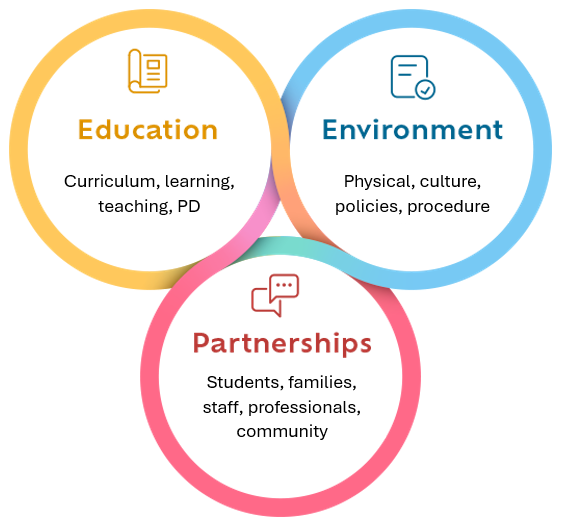
Refer to Guiding principle: Health promoting schools - a whole school approach for further information on implementing a whole school approach.
Family
Partnerships with school staff
Partnerships with agencies