
Learning objective
Students explore skills needed when dealing with challenging relationships and unsafe situations.
Take home messages
Curriculum links
WA HPE Curriculum
Sub-strand: Staying Safe
- Strategies are examined, such as communicating choices, seeking, giving and denying consent, and expressing opinions and needs that can support the development of respectful relationships, including sexual relationships.
Sub-strand: Interacting with others
- Skills and strategies to promote respectful relationships.
- Influences on sexuality and sexual health behaviours, including the impact decisions and actions have on own and others’ health and wellbeing
WA Curriculum General Capabilities
Personal and social capability
- Social awareness
- Self-management
- Social management
Ethical understanding
- Understanding ethical concepts and perspectives
Critical and creative thinking
- Analysing
- Reflecting
- Generating
International technical guidelines on sexuality education
Key concept 1.3 Friendship, Love and Romantic Relationships
- There are healthy and unhealthy sexual relationships.
- There are different ways to express affection and love as one matures.
Key Concept 4.1 Violence
- Everyone has a responsibility to advocate for people’s health and well-being free from violence
Key concept 4.2 Consent, Privacy and Bodily Integrity
- Consent is critical for healthy, pleasurable and consensual sexual behaviour with a partner.
- It is important to be aware of factors that can impact the ability to acknowledge or give consent.
Key concept 5.1 Norms and Peer Influence on Sexual Behaviour
- It is possible to make rational decisions about sexual behaviour.
Key concept 5.2 Decision-making
- Sexual decision-making has consequences on oneself and others, including social and health consequences.
Key concept 5.3 Communication, Refusal and Negotiation Skills
- Effective communication is key to expressing personal needs and sexual limits
Materials
- Teaching Resource: Sexuality cards [one class set]
- Teaching Resource: Respect and Consent Quiz [one quiz per student and one teacher answer sheet]
- Teaching Resource: He said, she said party script [one 2-sided copy per group]
Before you get started
- Protective interrupting - Teachers need to know and understand how to use this technique to prevent students from potentially disclosing sensitive information or abuse in front of other students.
- Managing disclosures - Teachers must be aware of school and legal procedures if a student discloses personal issues, particularly disclosures of sexual abuse.
- Self-esteem and confidence of some students may be an issue during this activity. Be reassuring and support students as they develop the ability to practise assertive “no” statements. This will also help students with their development of resilience and emotional wellbeing.
- Refer to Educator notes:
STIs/BBVs, Adolescent relationships Gender stereotypes and expectations and Respectful relationships for further content information related to this activity.
Learning activities
Group agreement
5 mins
Teaching tip: A group agreement must be established before any Relationships and Sexuality Education (RSE) program begins to ensure a safe learning environment. Read: Essential tools: Establishing a group agreement for tips on how to create one and what to include.
- Revise or create the class group agreement.
Trigger warning: Let students know you will be talking about relationships, both healthy and unhealthy relationships. Reiterate you want everyone to have safe, healthy, positive relationships, and while we will be promoting healthy behaviours, we do need to discuss unhealthy behaviours. Remind students of their right to pass and to speak to teacher/other support if required.
Sexuality card icebreaker
10 minutes
The following activity is intended to be used as an ice-breaker exercise to provide an opportunity to introduce some sexuality and relationships terminology that may be used and/or referred to throughout the lesson.
- Before the lesson prepare a class set of the Teaching Resource: Sexuality cards.
- Note: There is space provided to add in other words that are relevant to the class or words that have been brought up and discussed before.
- Make sure the additional words are relevant to the activity and remove those that may not be appropriate for the group.
- Have the whole class sit in a large circle.
Outline instructions of the activity:
Instructions
- The first student selects the top card from the deck of sexuality cards. They say the first word that comes to mind relating to the word on the card, for example, naked = sex; tolerance = acceptance; flirting = fun etc.
- Students place their card to the bottom of the ‘deck’.
- This continues around the circle.
- It’s important to remind students that they are allowed to 'pass' if they don’t feel comfortable speaking about their word (refer to class ground rules).
- Discuss with students the importance of respecting and supporting the choices of others and their own values and beliefs.
- Sit in the circle with the class. Model the first selection.
- Remind the class that although there are likely to be words mentioned that we may not say or talk about at school, we need to make sure that the words used are not offensive to other students.
- Emphasise that some words can have different meanings for different people, so it is important to communicate more about these topics if needed, to create a shared understanding.
When everyone has had a turn with a card, ask students to reflect on the activity and ask the questions:
Why is it important to know about words relating to sexuality and relationships?
What is the problem, if at all, if we all have different understandings of and meanings about these words?
Respect and consent quiz
15 minutes
The following activity will provide important information to remind students about respect, consent and consent and the law.
- Give each student a copy of the Teaching Resource: Respect and Consent Quiz (alternatively, display the Quiz electronically and ask students to note their own True/False responses in their notebooks).
- Have students complete the activity independently and then go through the correct answers with the whole class. (there is additional information for the teacher in the Teacher Guide).
Determine if the class is ready and there is time to proceed with the 'He said, she said' Party Script activity based on their level of understanding about consent.
'He said, she said' party script
25 minutes
Note: The small group Party Script activity should not be attempted before the Year 9 activity Sexual consent and the law has been completed.
The script will form the basis of discussion as students review and extend their existing knowledge of sexual consent. Students learn a range of skills and understand when to use and apply them if dealing with challenging or unsafe situations.
- Ask students to get into pairs or small groups of four.
- Provide each group with a copy of the Teaching Resource: He said, she said party script and ask them to focus on Party Script A.
- Give groups an opportunity to read through Party Script A and briefly discuss.
Show the following questions on a white/interactive board. Ask each group to respond to the question prompts as a whole class or discuss in small groups:
Did Emma give consent to have sex with Jacob? Where in the script does it support your answer?
What were some of the factors that influenced how both Emma and Jacob behaved?
(They were in an established relationship, alcohol, partying/celebration, location, trust, respect, body language, readiness, communication)
How could Jacob have responded differently?
(Checked to see if Emma was giving clear consent and was ok to have sex before going ahead)
At what point of the story could Jacob have done something differently?
(At Scene 7, Jacob could have asked Emma’s friends to go and lie down with her/check on her instead and talk to her later about why he didn’t think it was a good idea OR provide a couple of other scenarios)
Did Jacob and Emma have consensual sex?
(No. Giving consent means that everyone involved can clearly and freely agree to the sexual activities that will occur. If everyone is not willing or not able to give consent, e.g. if someone is asleep or under the influence of drugs or alcohol, then the sexual activity would be an assault and as such would be against the law. The law requires a person to be 16 years or older to provide consent to engage in any sexual activities)
Was it sexual assault?
(Yes. Sexual assault can be a violent, unexpected, traumatic and sometimes life-threatening event or series of events, even if the person has ‘passed out’. Sexual assault is ANY unwanted sexual act or behaviour which is threatening, violent, forced or coercive and to which a person has not given consent or was not able to give consent)
- Ask students to focus on Party Script B. In their small groups discuss where in the script the characters acted differently.
- Ask students to underline or highlight where in the script the characters demonstrated the following skills when they had to deal with an emotional, social and physically challenging situation (there may not be examples to find showing these skills):
- Refusal skills
- Communicating choices
- Acting assertively
- Expressing thoughts opinions & beliefs
Initiating contingency plans
A new script, a new ending
- Students apply their knowledge, skills and understanding of respect and consent to create a new script. It does not have to be a party script.
- If time is limited, students can edit the existing party script from Scenes 7 – 10 only. The following criteria must be met:
- The script demonstrates respectful behaviour and consent between the two characters.
- At least two of the following skills are included in the script (refusal, communicating choices, acting assertively, expressing thoughts opinions & beliefs and/or initiating contingency plans).
- At least two of the following questions are included in the script.
- What do you want to do?
- Are you ready to do this?
- Is there anything that you’re not comfortable doing?
- Do you want to stop?
- Are you happy to go further?
Join pairs or small groups together. Each pair/small group reads through their new script. The other group members should be actively listening to ensure the set criteria have been met.
Alternate activity: Students create their new script as a short play or electronic presentation.
3-2-1 Reflection
Reflection
10 minutes
Students watch a YouTube clip. The clip shows young people at a party drinking and dancing. Two of the characters go into the bedroom but the young male involved decides to walk away and not try and have sex with a very intoxicated young female.
Partying and consent (https://youtu.be/YoUPqH_i_Qs) [6:29min].
Ask students to reflect on the storyline presented with the following question in mind:
How does this clip demonstrate respect and consent?
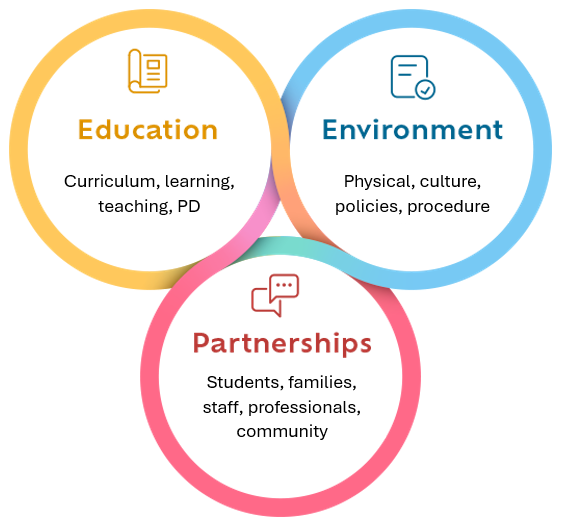
Health promoting schools
Refer to Guiding principle: Health promoting schools - a whole school approach for further information on implementing a whole school approach.
Education
Professional Development
- Additional resource to support teachers with delivery of RSE: The practical guide to love, sex and relationships. A teaching resource from the Australian Research Centre in Sex, Health and Society, La Trobe University.
Partnerships
Family
- Talk Soon. Talk Often: a guide for parents talking to their kids about sex is a free hardcopy resource that can be bulk ordered by schools and website. Send a copy home to parents prior to starting your RSE program. The booklet offers ages and stage related information on puberty (and other topics) so that parents can reinforce the topics covered in class. (How to order hard copies.) Provide the link to parents on school websites and social media.
Students
- Encourage students to look at The Line - a resource for those aged 14+ covering topics such as relationships, dating, sex and comfort zones.